
Why Are You Here?
That was one of the first questions my guitar instructor, Michael Dailey, ever asked me.
And he didn’t ask it gently.
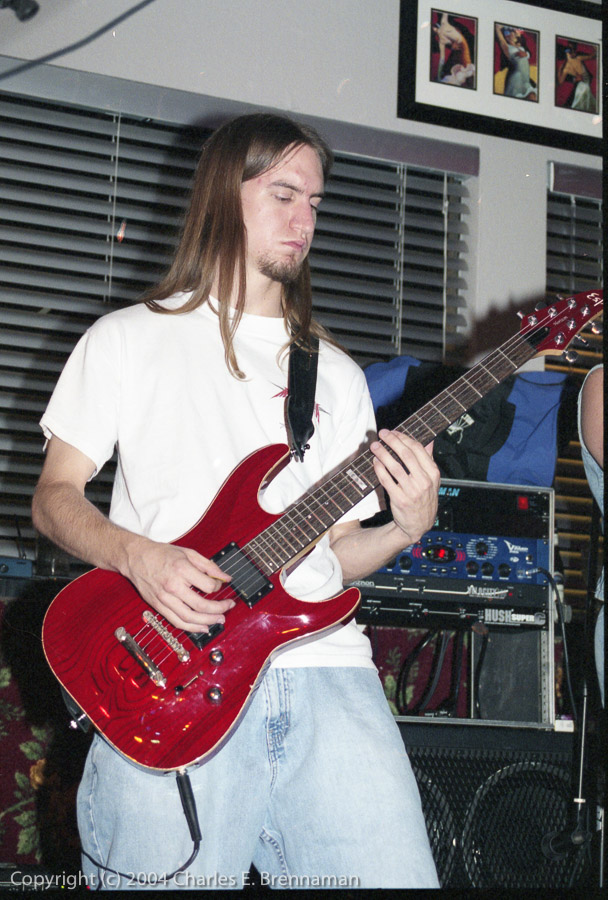
It was late. Really late. Somewhere around 11:00 at night, if my memory is right. I was 21 years old, had long hair, still smoked cigarettes, and I had probably come directly from band practice. Which means I probably smelled like band practice. You can interpret that however you want.
I was sitting next to Michael with my guitar out when he looked at me, very sternly, and asked:
“Why are you here?”
I remember leaning back in my chair…
I don’t know if I actually said, “Excuse me?” but that was certainly the feeling.
Why was I there?
Well…to learn guitar.
More specifically, classical guitar.
Wasn’t that obvious?
But that wasn’t really what he was asking.
And looking back more than twenty years later, I think there were actually two questions buried inside that one.
“Why Are You Here?”
To understand the first question, you have to understand how I ended up sitting there at 11:00 at night in the first place.
A few months earlier, near the end of 2003, I attended a faculty concert at Tarrant County College Northwest. Two classical guitarists performed that evening: Will Douglas and Michael Dailey. Will was very good. I remember being impressed.
Then Michael played….
One of the pieces was Francisco Tárrega’s Recuerdos de la Alhambra. He played another piece that night as well, although after all these years I no longer remember what it was.
But I remember Recuerdos. (Sí…tengo recuerdos de Recuerdos.)
I remember what it felt like.
There are good performers. There are great performers. And then, every once in a while, there is someone who completely removes you from wherever you happen to be sitting.
As a performer myself, I know what it feels like to occasionally disappear into the music. There are moments onstage when everything else goes away and you become completely absorbed in what you’re doing.
What Michael did was different.
He made me disappear into it.
For those few minutes, I wasn’t sitting in a small performance hall at a community college. I wasn’t evaluating his technique. I wasn’t looking around the room. I wasn’t thinking about what I was going to do afterward.
I was in Michael’s world.
I was completely absorbed in his performance.
Saying that he “took me on a journey” almost understates it.
And I remember my reaction:
“That’s the guy. That’s who I want to teach me guitar.”
Not Just Any Teacher
By that point, I already knew how to play guitar. I played electric guitar. I played in bands. I learned songs, wrote songs and performed. I could read music. I had started working through some classical material on my own. I had even been teaching guitar lessons myself for about two years or so.
But classical guitar was different. I could look at the notes on the page, work through them, study the pieces and figure them out. I could slowly work my way through pieces. I had used books, worked on fingerstyle playing, and developed some basic understanding of the general mechanics.
But I had reached that frustrating point where I knew enough to realize that I didn’t know much.
I could play some of it. I just wasn’t progressing.
And then I watched Michael play.
There was an enormous distance between what I was doing and what I had just watched him do. I wanted to understand how to cross that distance.
So I signed up for lessons with him.
There was one problem.
Michael was full.
And when I say full, I mean his teaching schedule was ridiculous. He would start sometime around 9:00 or 10:00 in the morning and teach throughout the day and into the night. No gaps. No real breaks. I think he took a lunch.
He suggested that I study with Will instead.
That was a perfectly reasonable suggestion. Will had studied with Michael for years, was already an excellent guitarist, and was working toward his doctorate in music. He was Michael’s protégé.
But Michael was the reason I was there.
I had watched him perform and thought: “That’s the guy. That’s who I want to teach me guitar.”
I wasn’t looking for just any teacher. I wanted the person who had made me feel that way about the instrument.
I don’t remember the exact words I used on that phone call all those years ago, but whatever I said eventually must have convinced Michael to give me a shot.
I wouldn’t really say he found room in his schedule. There wasn’t any. He normally had no intention of still being there that late. What he did was add me onto the very end of an already-full day.
At 11:00 at night.
He was booked solid, and that was the only option.
I took it without hesitation.
For that first semester, I was basically stuck at the end of the schedule.
For a while, my schedule was almost absurd: class in the morning, grab lunch, cram in whatever homework and practice I needed to do for myself, teach my own students through the afternoon and early evening, and on lesson night, hit a drive-through on the way to rehearsal, play with my band from roughly 7:00 until 10:00, pack up, drive over to the college, and take a classical guitar lesson with Michael at 11:00 at night.
It was so late that the exterior doors had already locked. I’d stand outside and wait for Michael to come let me into the building.
It was late for both of us. But I wanted that lesson badly enough that, as far as I was concerned, if Michael was willing to teach at 11:00, I was willing to be there.
I remember walking back out into a basically empty parking lot, with just my truck and Michael’s car still sitting there.
Sometimes I think about what I must have looked like walking into those lessons.
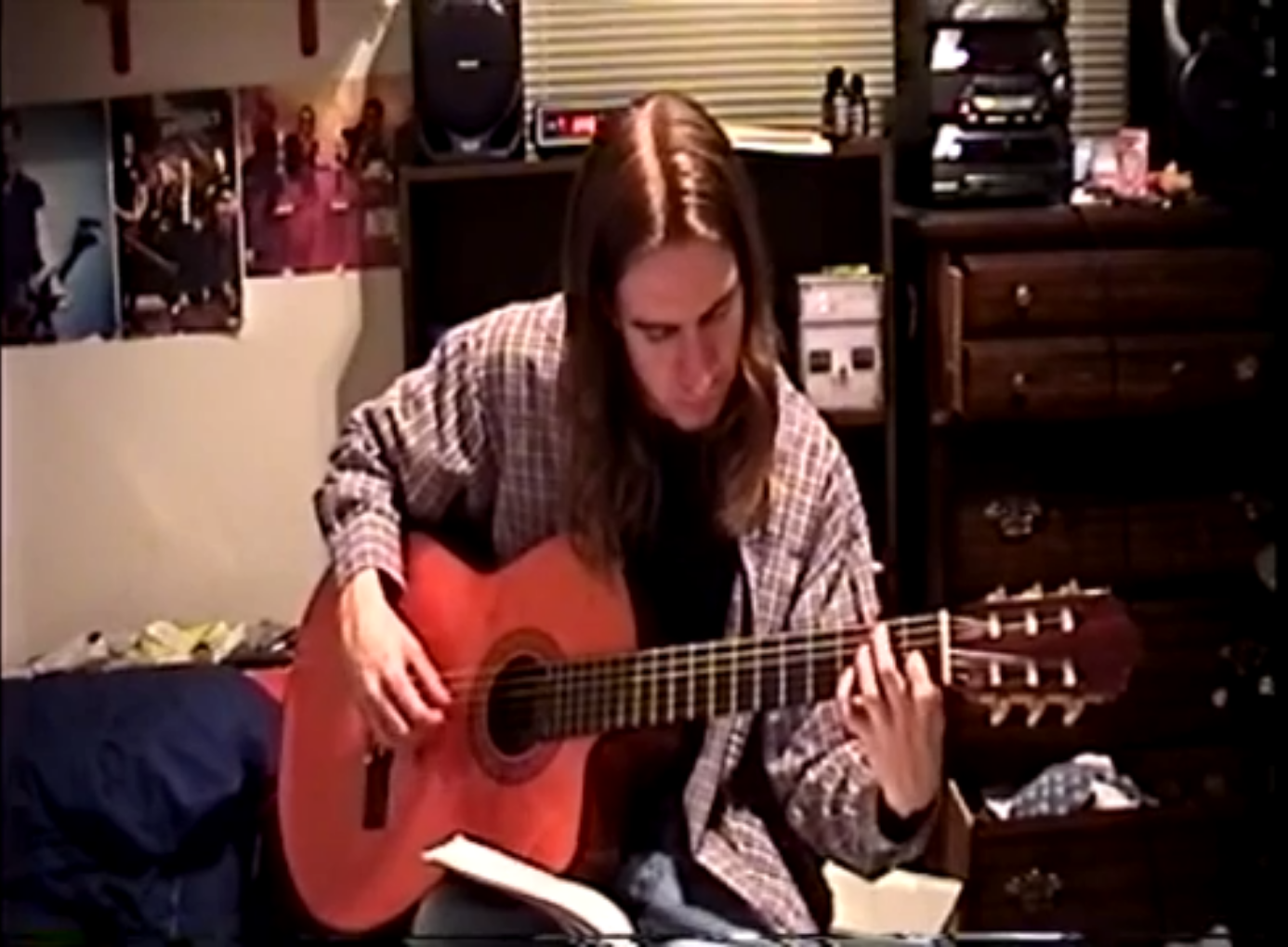
Twenty-one years old. Long hair. Coming from band practice. Probably smelling like cigarettes, sweat and everything else that came with being a 21-year-old musician rehearsing in a garage.
And to complete the picture, I showed up carrying an orange Alvarez classical-style guitar with a cutaway and electronics.
If you know much about traditional classical guitar, the cutaway and electronics already tell you something.
I was not exactly Andrés Segovia walking through the door.
Looking back, those late lessons almost felt like I was proving myself and working my way into his schedule.
So after teaching for somewhere around twelve or thirteen hours, Michael is looking at this kid who had been so determined to get onto his already-full schedule.
And he asks:
“Why are you here?”
In hindsight?
Fair question.
The First Answer Wasn’t Good Enough
I think my first answer was something generic.
“To learn.”
Or maybe:
“To learn classical guitar.”
Whatever I said, it clearly wasn’t enough.
He came back to the question again—maybe not in those exact words, but with the same meaning:
Why are you here?
That was when I had to actually explain myself.
I had gotten interested in classical guitar. I had tried learning some of it myself. I could read the music and slowly work through pieces, but I felt stuck.
I didn’t think I was doing it correctly.
I knew how to play guitar, but I also knew enough to recognize that I was missing something.
And then I had watched him play.
That was what I wanted.
Not simply to copy one piece or learn one technique.
I wanted to get closer to whatever I had just witnessed at that concert.
He had shown me a level of playing that I didn’t know how to reach on my own.
That was why I was there.
Now I Understand the Question
At 21, “Why are you here?” sounded harsh.
And to be fair to my memory, I think there probably was a little harshness in it.
It was after 11:00 at night. Michael had been teaching all day. I had pushed my way into a schedule that didn’t really have room for me.
And then I showed up looking like…well, me at 21.
There was probably at least a little bit of:
Why the hell are you here?
But there was another question underneath it.
It is the question I understand much better now because I have spent years sitting in the other chair.
What are you trying to accomplish?
Why did you pick up this instrument?
What do you want from these lessons?
Where are you trying to go?
Those questions matter.
Today, when someone starts taking guitar lessons with me, I don’t usually stare at them sternly and demand:
“Why are you here?”
I tend to phrase it a little more gently.
What made you interested in guitar?
What kind of music do you want to play?
Do you want to play for fun?
Do you want to perform?
Do you want to join a band?
Write songs?
Study music seriously?
Major in music?
Is there one particular song you’ve always wanted to play?
Because I cannot really decide how to teach someone until I understand what they want the instrument to become in their life.
The Destination Matters
Students sometimes assume there is one correct path to learning guitar.
There isn’t.
There are fundamentals that matter. There are skills I want nearly everyone to develop. There are things I may recognize that a student needs long before the student recognizes them.
But the destination still matters.
Someone who wants to strum songs around a campfire does not necessarily need the same path as someone preparing for a college music audition.
A teenager who wants to play lead guitar in a rock band may need a different path from an adult who has dreamed for twenty years about playing classical guitar.
A good teacher has to determine where the student is standing now, understand where the student wants to go, and then build a realistic path between those two places.
The destination can be structured.
The route has to remain flexible.
And none of that begins until you understand why the student is there.
I Thought I Knew Why I Was There
There is another part of Michael’s question that I understand differently now.
At 21, I thought I knew exactly why I was sitting in that chair.
I wanted to become a better guitarist.
That was true.
It just wasn’t the whole answer.
I went on to major in Music Performance.
I eventually followed Michael to Texas Wesleyan University. He was the reason I chose to go there.
I continued performing.
I continued teaching.
And as the years went by, more and more of the things Michael taught me became part of the way I approached the instrument—and eventually part of the way I approached my own students.
I had already done some teaching when I met him, but I certainly did not understand teaching then the way I understand it now.
Twenty-plus years later, I still think about a question he asked during one of our first lessons.
That says something.
The strange part about getting older is realizing how much certain people changed the direction of your life before you were old enough to understand that they were doing it.
Michael was not some ancient professor when I met him.
He was only a few years older then than I am now.
That fact feels completely different to me today.
At 21, he seemed like an established teacher who possessed a level of musicianship that might as well have existed on another planet.
Today, I can look back and see him as a working musician and teacher, giving one more lesson after an incredibly long day because some stubborn kid had watched him play two pieces and refused to study with anybody else.
I have more to thank him for than I could have understood then.
Probably more than I fully understood while I still had the opportunity to tell him.
And that is the part I wish I could change.
Michael is no longer here for me to sit across from him and explain what happened after that first lesson—where the path led, what I learned from him, and how many of those lessons eventually found their way into my own teaching.
I wish I could tell him.
Maybe this is one way of doing that.
So when a new student sits down across from me today, I still want to know the answer to Michael’s question.
I just usually ask it a little more gently.
Why are you here?